The Ogura Hundred Poets was completed during the Kamakura period. Fujiwara no Teika compiled them by taking one poem each from 100 of the best poets in chronological order from Emperor Tenji to the Retired Emperor Juntoku to decorate the sliding doors at the Ogura mountain villa, the summer home of the general and poet Utsunomiya Yoritsuna. Many of selected poems were ornamental in nature, considering they were meant to be used as decoration. Seventy-nine male poets! 20-one female poets! I am particulary attracted to the works of female poets! You lot can feel the seasons and modesty in ways that tin can't be found in modernistic poetry! - Kanade Oe
The Ogura Hyakunin Isshu (小倉百人一首), frequently but called Hyakunin Isshu (lit. "Ane Hundred Poets, I Poem [Each]") or Hundred Poets, is a collection of 100 traditional Japanese poems past 100 Japanese poets. The drove dates from the 12th century, and was compiled past the Japanese poet Fujiwara no Teika while he lived in the Ogura district of Kyoto, hence its name. The poems in the Ogura Hyakunin Isshu form the ground for the Karuta deck.
Contents
1Notes
2Opening Verse form - At present the Bloom Blooms
2.iAuthor
2.2Genre
2.threeStory
2.ivKaruta Card Type
2.5Trivia
3one. Of the Autumn Rice Field
three.oneAuthor
three.twoGenre
3.3Story
3.4Karuta Card Type
3.5Related Links
42. So Jump Ends and Summer Comes
4.oneWriter
4.twoGenre
iv.3Story
4.fourTrivia
4.fiveKaruta Card Blazon
4.6Related Links
v4. No Affair Where I Stand
5.1Author
v.2Genre
5.3Karuta Card Type
six6. The Night is Well-nigh Past
half-dozen.1Writer
6.2Genre
6.iiiKaruta Menu Type
viivii. Which Shines over Mountain Mikasa
seven.1Author
7.twoGenre
7.3Karuta Card Blazon
89. So The Blossom Has Wilted
8.iAuthor
8.2Genre
8.3Karuta Carte Type
9x. Substitution Hellos And Goodbyes
nine.oneAuthor
ix.2Genre
9.iiiKaruta Card Blazon
1011. To Tell the People in the Capitals That I Brand for the Islands
x.1Writer
10.2Genre
10.3Karuta Card Blazon
1112. The Sky is the Road Abode
xi.1Author
xi.iiGenre
xi.threeKaruta Menu Type
12xiii. Feel Love Deepen
12.1Author
12.twoGenre
12.3Karuta Bill of fare Blazon
13xv. For y'all, I head out
13.oneAuthor
xiii.2Genre
thirteen.3Karuta Carte du jour Type
xiv16. Every bit the Inaba Mountain Pines
xiv.1Writer
14.2Genre
fourteen.3Karuta Card Type
xv17. The Red That Is
xv.1Author
15.iiGenre
15.3Story
15.ivNotes
15.5Rhetorics
15.6Karuta Bill of fare Type
fifteen.7Related Links
sixteen18. In My Dreams, I Creep Closer to You
sixteen.1Author
16.2Genre
16.iiiKaruta Card Blazon
1722. Gust of Current of air
17.1Author
17.twoGenre
17.3Story
17.4Karuta Bill of fare Type
1823. When Looking at the Moon
eighteen.1Author
18.iiGenre
18.3Karuta Card Blazon
1926. The Fall Leaves of Mountain Ogura
19.aneAuthor
19.2Genre
nineteen.iiiKaruta Card Type
xx31. From the Crystal White Snow
xx.aneAuthor
20.2Genre
xx.iiiKaruta Card Type
2133. A Cyclone of Blossom Petals Descends
21.1Author
21.iiGenre
21.3Karuta Carte du jour Type
2234. None Are Left Who Know Me
22.iWriter
22.twoGenre
22.3Karuta Menu Type
2335. The Plum Blossoms Still Smell the Same
23.oneAuthor
23.2Genre
23.threeKaruta Menu Type
2437. As Though Pearls Have Been Strung Across the Autumn Apparently
24.1Writer
24.twoGenre
24.3Karuta Card Type
2540. But I Cannot Hibernate
25.aneWriter
25.twoGenre
25.3Story
25.fourKaruta Bill of fare Blazon
2641. As My Love Offset Came to Realization
26.1Author
26.2Genre
26.iiiStory
26.4Karuta Menu Blazon
2742. Impassioned Vows
27.aneWriter
27.2Genre
27.threeKaruta Menu Type
2846. I Do Not Know Where This Dear Volition Take Me
28.1Writer
28.2Genre
28.3Story
28.4Trivia
28.5Karuta Card Type
2947. Simply For Autumn'southward Coming
29.iAuthor
29.2Genre
29.3Karuta Carte Type
30l.
xxx.1Writer
30.2Genre
30.3Karuta Card Type
3151. How Can I Tell Her
31.aneWriter
31.2Genre
31.3Karuta Card Type
3253.
32.1Author
32.iiGenre
32.3Karuta Bill of fare Type
3354. My Fearfulness is That You Will Forget
33.1Author
33.iiGenre
33.threeKaruta Menu Type
3455. The Sounds of the Waterfall
34.1Writer
34.2Genre
34.iiiKaruta Carte du jour Type
3557. Long Last Nosotros Meet
35.aneAuthor
35.2Genre
35.threeKaruta Card Type
3660. Past Ōe Mountain
36.aneAuthor
36.2Genre
36.3Story
36.ivKaruta Bill of fare Blazon
3761. Now Blossom Inside the Ninefold Palace
37.1Author
37.2Genre
37.threeKaruta Card Type
3862.
38.1Author
38.iiGenre
38.3Karuta Card Type
3963. After I Determined to Carelessness
39.1Author
39.2Genre
39.3Karuta Bill of fare Type
4066. For There Is No One Else Out Here
40.1Author
40.iiGenre
twoscore.3Story
40.4Karuta Card Type
40.fiveRelated Links
4168.
41.1Writer
41.twoGenre
41.3Karuta Card Blazon
4269. To Prepare the Tatsuta River Ablaze
42.1Author
42.2Genre
42.3Karuta Carte du jour Type
4370.
43.iWriter
43.twoGenre
43.iiiStory
43.4Karuta Card Type
4472. While Some Dodge the Famous Waves
44.oneAuthor
44.2Genre
44.iiiStory
44.4Karuta Carte Type
44.5Related Links
4573. Nobody Wishes to Run into the Beautiful Crimson Blossoms
45.1Writer
45.2Genre
45.3Karuta Card Type
4676. The Cresting Waves Almost Look Like Clouds in the Skies
46.1Author
46.2Genre
46.3Karuta Menu Type
4777. Swift Waters Parted by the Jagged Rocks
47.1Author
47.2Genre
47.3Story
47.4Trivia
47.vKaruta Carte Type
4879. Moonlight, Clear and Bright
48.1Author
48.twoGenre
48.threeKaruta Menu Type
4983. World Offers No Escape
49.1Author
49.2Genre
49.3Karuta Carte du jour Blazon
5084. As the Years Laissez passer
50.aneAuthor
fifty.2Genre
50.3Story
fifty.4Karuta Bill of fare Type
5186. May My Sighs Be Blamed upon the Moon
51.1Author
51.2Genre
51.iiiKaruta Carte du jour Type
5287. Pelting Takes Longer to Dry
52.iAuthor
52.2Genre
52.3Story
52.4Karuta Card Type
5389.
53.1Author
53.2Genre
53.3Karuta Card Type
5493. The world offers no change
54.iWriter
54.2Genre
54.3Karuta Carte du jour Type
5597.As I Wait For Someone
55.1Writer
55.twoGenre
55.3Karuta Card Type
5698.The Only Sign of Summer
56.1Author
56.2Genre
56.3Karuta Card Blazon
57100.Exist Equally Dear Now, Those Were the Good Old Days
57.aneAuthor
57.2Genre
57.iiiKaruta Bill of fare Blazon
58The Red Dusk (from 10 Thou Leaves)
58.1Writer
58.2Genre
58.3Story
59References
60External links
Notes
Poems are displayed in three forms: Subber's translation, Alternative text translation and Rōmaji/Kanji text.
A 31-syllable Tanka verse form typically doesn't have an official title other than its author's name. In this wiki folio, the names shown adjacent to numbers are made upwards by the writer of this article for the sake of convenience.
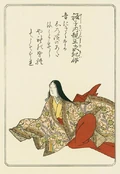
Woodblock print images are used under Creative Commons license of David Bull.
Hyakunin Isshu Day was celebrated on May 27, 2016.
Opening Poem - At present the Blossom Blooms
For The episode "Now the Flower Blooms", meet Episode 1.
Take y'all heard? One of the new students is the younger sister of the model Ayase Chitose! - Episode 1
Naniwa Bay, now the blossom blooms, but for winter. Here comes jump, now the bloom blooms.
In Naniwa Bay, now the flowers are blossoming. Later on lying dormant all winter, at present the leap has come up and the flowers are blossoming.
Naniwa-zu ni/Sakuya kono hana/Fuyu-gomori/Ima o haru-exist to/Sakuya kono hana 難波津に 咲くやこの花 冬ごもり いまを春べと 咲くやこの花
Wani, a semi-legendary scholar who is said to have come to Japan from Baekje (nowadays-twenty-four hour period Korea) around the late 3rd century.
Genre
Spring scenery
Story
Subsequently the 3 years of interregnum, the 16th emperor of Japan, Emperor Nintoku, finally assumed the Imperial Throne. The poem was written to celebrate the reign of the emperor and to wish for his reign to flourish.
This poem really has nothing to do with the Ogura Hyakunin Isshu; it is from the Kokin Wakashu, a verse form anthology which was compiled about 300 years prior to Ogura. During the Heian period, it was considered the showtime poem that any poet should learn; hence it is now used as the opening poem in competitive karuta matches.
The flower here refers to plum blossoms, which blossom prior to the advent of jump. The coming leap implies the start of a new era. Thus it is an appropriate opening for the Chihayafuru story.
Karuta Menu Type
Opening verse form - not a karuta card
Trivia
The tomb of Emperor Nintoku is said to be the biggest tomb in the globe, though the fact is lesser known to the globe for some reason.
Meiji period poet Nobutsuna Sasaki is said to have suggested this verse form as an advisable prelude for competitive karuta.
1. Of the Autumn Rice Field
For The episode "Of the Autumn Rice Field", see Episode 45.
For The episode "As My Sleeves Are Moisture With Dew"[1], encounter Episode 21.
Incredible... Incredible! Incredible! Incredible! Teach me more, Kana-chan! Starting from The Fall Paddy! Huh? All one hundred poems?! - Episode 6
The autumn paddy shacks have rough thatching as my sleeves are wet with dew.
Of the autumn paddy, shacks have crude thatching. Sheltering there, my sleeves are wet with dew.
Aki no ta no/Kariho no io no/Toma o arami/Waga koromode wa/Tsuyu ni nure tsutsu 秋の田の かりほの庵の 苫をあらみ わが衣手は 露にぬれつつ
Author
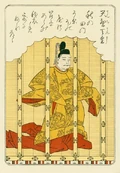
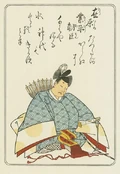
Emperor Tenji by David Bull
Emperor Tenji (male person, 626-672). The 38th emperor of Japan.
Genre
Autumn scenery
Story
Quoting Kanade
This poem is supposed to have been written by Emperor Tenji, but it is believed that this was edited from an anonymous poem in the Collection of Ten G Leaves. A paddy shack is a minor motel for farmers. When the farmers residual nether the crude roof of sedge and strew, They notice that their sleeves are wet with dew. So Fujiwara no Teika may accept started with this poem to convey the idea of an platonic emperor who sympathise the hard work of the farmers. - Episode 6
Emperor Tenji, aka Prince Naka no Oe, is known for the revolution rising confronting Soga clan, including the assasination of the onetime ruler Soga no Iruka. The incident was successful, and he later firmed the foundation of long-lasting Japanese Imperial reign. This poem proves that he was highly respected as a tender-hearted good ruler despite of the brutal incident of his younger age. Mayhap the name of Oe Kanade is taken from his alternative name?
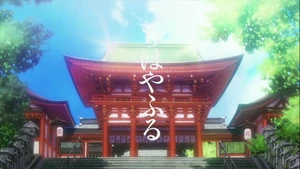
Oumi Jinguu Shrine in Chihayafuru OP.
The Emperor Tenji is enshrined in Oumi Jinguu Shrine in Shiga Prefecture. Celebrating the Number one of Ogura Hyakunin Isshu, the shrine hosts the annual National Karuta Competition which all the Karuta players dream of participating at. The highlight of the tournament is, of cource, the title match for Master and Queen. The very beginning of Chiahayafuru manga Vol.ane starts with the scene Chihaya fighting the Queen title match! How long we need to wait until the actual story will come?
Karuta Menu Type
Three Syllable Menu (A-ki-no)
Tenji Tenno from David Balderdash'south Hyakunin Isshu Woodblock print serial
two. So Spring Ends and Summertime Comes
Ōe-san! The upperclassmen are throwing a fit! - Episode six
So jump ends and summer comes. Now white robes hang to dry on Mount Amanokagu.
The spring has passed and the summer come up once again; For the white robes are spread to dry on the Mount of Kaguyama.
Haru sugite/Natsu ki ni kerashi/Shirotae no/Koromo hosuchou/Ama-no-Kaguyama 春過ぎて 夏来にけらし 白妙の 衣干すてふ 天の香具山
Author
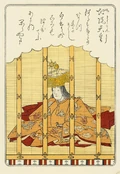
Emperor Jitoh by David Bull
Empress Jitoh, The 41st emperor of Japan.
Genre
Summer scenery
Story
This is a landscape poem well-nigh the beautiful contrast of verdurous mountains and pure-white robes. The green of immature leaves is the signature colour for early on summertime, which comes after the pink of cherry flower season.
And of course, a expert kimono coordinator like Kanade never misses the seasonal senses.
Japanese Color Moegi-iro 萌黄色 #A9D159
The color of yellowish green chosen "Moegi(-iro)" brings to mind the leaf bud of early on summer. In Heian era, Information technology was favored as a colour for young people.
Japanese phrase "新緑の候" ("the season of verdure" "the flavour of fresh greenly") indicates the season effectually March. At the age of Empress Jitoh, there was a palace ceremony of Koromogae (Updating Wardrobe) in this flavour. The ladies-in-waiting packed their winter clothes, and they hung their summertime clothes out for ambulation. Seeing the white robes hung on Mount Kaguyama, the Empress Jitoh imagined the beautiful scenery was like a work of heavenly ladies, for the legend said that the Mount of Ama-no-Kaguyama in Nara Prefecture had fallen from the heaven. (Ama-no- means "heavenly".)
Kana-chan recites this verse form at the beginning of Chihayafuru anime episide 6. Information technology's not only because she was hanging a towel on her head, but maybe the mangaka is trying to tell the advent of new season, with the meassage of "we are moving to the next stage."
Empress Jitoh was a daughter of the Emperor Tenji. She is as well known as her childhood name of Princess Unono Sarara, which sounds very anime-ish cutesy proper name for today's standard. She decided to enthrone herself after being bereaved of both her husband, Emperor Tenmu, and her prince.
The established manga artist Machiko Satonaka has been writing the dramatic biography of the Empress as her lifework ("Tenjo no niji (The Rainbow in the Heaven)").
Trivia
The anniversary of Koromogae was lost at the historic period of the editor of the Ogura Hyakunin Isshu. So he modified the original poem,
The jump has passed and summer comes again. White robes are spread to dry out on Mount Ama-no-Kaguyama (春過ぎて 夏来たるらし 白妙の 衣ほしたり 天の香具山)
to
The spring has passed and summertime comes again. White robes were spread to dry out on Mountain Ama-no-Kaguyama, and so they say. (春過ぎて 夏来たるらし 白妙の 衣ほす てふ 天の香具山)
when he compiled the collection. Perhaps the modern concept of copyright is but a senseless greed for people of the past?
Karuta Card Type
Three Syllable Card (Ha-ru-su)
Jito Tenno from David Balderdash'south Hyakunin Isshu Woodblock impress serial
Empress Jitoh from Machiko Satonaka's lifework manga series "Rainbow in the Sky - the Legend of Empress Jitoh- "
4. No Matter Where I Stand up
For The episode "No Matter Where I Stand", see Episode twoscore.
For The episode "On Mt. Fuji's Lofty Peak, by the Drift of Falling Snow", see Episode l.
Arata, take care of her. The four of us can yet win this match. - Episode 13
No affair where I proceed the shores of Tago, I tin look upwardly and see white snow, information technology keeps falling on the cap of Mount Fuji.
Tago no ura ni/Uchi-idete mireba/Shirotae no/Fuji no takane ni/Yuki wa furitsutsu 田子の浦に うち出でて見れば 白妙の 富士の高嶺に 雪は降りつつ
Author
Kakinomoto no Hitomaro
Genre
Wintertime scenery
Karuta Carte du jour Type
Two Syllable Card (Ta-go)
half-dozen. The Night is Nearly By
For The episode "The Night is Nearly Past", encounter Episode 23.
If i gaze upon the imperial courtroom bridge's arc, which the magpie spread on, filled which white frost, and so i know the dark is almost past.
I gaze out across the garden dim, Here in the deepening night, Just like Tanabata's magpie bridge, A gleaming frosty arc.[two]
Kasasagi no/Wataseru hashi ni/Oku shimo no/Shiroki wo mireba/Yo zo huke ni keru かささぎの 渡せる橋に おく霜の 白きを見れば 夜ぞふけにける
Author
Ōtomo no Yakamochi
Genre
Winter scenery
Karuta Card Type
Two Syllable Card (Ka-sa)
7. Which Shines over Mount Mikasa
For The episode "Which Shines over Mount Mikasa", encounter Episode 33.
When I look upon the wide plain of heaven, it is the moon that rose from Mount Mikasa is the same moon that is in the state of Kasuga.
Is this the very same moon I gaze on here tonight That behind Mikasa Mountain One time bathed me in its light?[two]
Ama no hara/Furi sake mireba/Kasuga naru/Mikasa no yama ni/Ideshi tsuki kamo 天の原 ふりさけ見れば 春日なる 三笠の山に 出でし月かも
Author
Abe no Nakamaro
Genre
Travel
Karuta Carte Type
3 Syllable Card (A-ma-no)
9. So The Blossom Has Wilted
For The episode "So The Bloom Has Wilted", run across Episode 26.
For The episode "Merely as My Beauty Has Faded", see Episode 22.
For The episode "My Life Passes by in Vain equally I Watch the Long Rain Fall", meet OVA 1.
The color of the flower has faded, while I lost myself in idle thought in this long pelting.
I came to this hut in Uji, The sorrows of the world to flee; "To live on the Mount of Sorrows!" I hear them say in glee.[2]
Hana no iro wa/Utsuri ni keri na/Itazura ni/Waga mi yoni furu/Nagame seshi ma ni 花の色は うつりにけりな いたづらに わが身世にふる ながめせし間に
Author
Ono no Komachi
Genre
Leap scenery
Karuta Bill of fare Type
Three Syllable Card (Ha-na-no)
ten. Exchange Hellos And Goodbyes
For The episode "Exchange Hellos And Goodbyes", meet Episode 10.
For The episode "They All Exchange Hellos and Goodbyes at the Gates of Osaka", see Episode 32.
The stranger who has traveled far...
The stranger who has traveled far,the friend with welcome smile, all sorts of men who come and get run into at this mountain stile,—they meet and rest awhile.
Kore ya kono/Yuku mo kaeru mo/Wakarete wa/Shiru mo shiranu mo/Ousaka no seki これやこの 行 くも 帰 るも 別 れては 知 るも 知 らぬも 逢坂 の 関
Author
Semimaru
Genre
Others
Karuta Card Type
Two Syllable Card (Ko-re)
11. To Tell the People in the Capitals That I Brand for the Islands
For The episode "To Tell the People in the Capitals That I Make for the Islands", run across Episode 29.
Let the heavenly winds blows through the path among the clouds, so that nosotros may detain these maiden messengers a while longer.
Over the wide bounding main towards its many afar isles my ship sets sheet. Will the fishing boats thronged there proclaim my journey to the world?
Wata no hara/Yaso shima kakete/Kogi idenu to/Hito ni wa tsuge yo/Ama no tsuribune わたの原 八十島かけて こぎ出でぬと 人には告げよ あまの釣舟
Writer
Ono no Takamura
Genre
Travel
Karuta Bill of fare Type
Six Syllable Card (Wa-ta-no-ha-ra-ya)
12. The Sky is the Road Home
For The episode "The Sky is the Road Home", meet Episode 11.
Oh stormy winds, bring upward the clouds...
Oh stormy winds, bring upward the clouds, and pigment the heavens gray; lest these fair maids of course divine should affections wings display, and wing far far abroad.
Ariwara no Narihira (male person, 825-880), one of the Six Immortals of Poetry and the Thirty-half-dozen Poesy Immortals.
Ariwara no Narihira by David Bull
Genre
Fall scenery
Story
Quoting Kanade:
I believe that this poem is most passionate beloved. Did you know that Nijo no Kisaki was in honey with Ariwara no Narihira before she married the emperor? This is a very famous story. This poem was displayed on a folding screen in the palace. Some accounts say that Nijo no Kisaki was the ane who requested the poem. I like how Narihira concealed his passion for her in a scenic rendering since he wasn't able to forget her. "Chihayaburu" is a pillow word (epithet) for gods that implies nifty force. "Mizu kukuru" tin can be interpreted as "water goes nether cherry leaves" or "water looks like being tie-dyed," but I believe that the crimson leaves stand for a love that never faded even after the separation. - Episode vi, Flavour i
Quoting Kanade:
"Chihayaburu" is a spinning height standing perfectly upright. It repels everything that touches information technology and standing unchangingly firm, calm, and stable. -Episode 7, Season 2
How the story is and then famous? After Lady Fujiwara no Takaiko married the Emperor and became Nijo no Kisaki (Empress of Nijo), the author and ex-lover Ariwara no Narihira tried to exile with her... an elopement with Empress! However his unprecedented attempt was failed and the empress was brought dorsum to the palace. We don't know whether he was punished or non, merely it is considered that this incident had held back on his promotion. This anecdote caused people to meet him as anti-establishment handsome nobleman, and he became the hero of romance novels like The Tales of Ise (10th century). Even the famous The Tale of Genji (10th century) is said to exist heavily influenced by it.
Notes
Tatsuta River is a stream in Nara prefecture, where the uppercase was in that location effectually his age. The name of Tatsuta came from the goddess of autumn Tatsuta-hime who is said to be a tomboy merely like Chihaya. The "I have never heard" part can exist interpreted as that it is unheard of for tomboyish Tatsuta to practice a feminine behavior like dying.
Tenji Tenno from David Bull'due south Hyakunin Isshu Woodblock print series
Image Photo from 4travel
18. In My Dreams, I Pitter-patter Closer to Y'all
For The episode "In My Dreams, I Creep Closer to You lot", see Episode 38.
On the shore of Sumi'southward bay , the waves had gathered. At night, I shall go to yous in my dream. Allow none known.
Sumi no e no/Kishi ni yoru nami/Yoru sae ya/Yume no kayoi ji/Hitome yo kuran 住の江の 岸による波 よるさへや 夢の通ひ路 人目よくらむ
Author
Fujiwara no Toshiyuki
Genre
Love
Karuta Carte du jour Type
One Syllable Card (Su)
22. Gust of Current of air
For The episode "Gust of Wind", meet Episode 42.
Gust of wind carries leaves from the copse, giving the name of tempest to the mountain wind.
Information technology is by its jiff That autumn's leaves of trees and grass Are wasted and driven. And then they telephone call this mount wind The wild i, the destroyer.
Fukukara ni/Aki no kusaki no/Shiorureba/Mube yamakaze o/Arashi to iuran. 吹くからに 秋の草木の しをるれば むべ山風を あらしといふらむ
Writer
Fun'ya no Yasuhide
Genre
Autumn scenery
Story
Chihaya 'south kickoff carte du jour. Her remarkable hearing ability allows her to hear the hard 'Thousand' (F) in Gust (Fu), allowing her to accept the card. It was her outset card that she won confronting Arata and Shinobu.
Karuta Card Type
One Syllable Card (Fu)
23. When Looking at the Moon
I don't really empathize how you lot tin go sentimental most looking at the moon, just when I run across a menu that I've practiced constantly on the tatami, I get a confidence boost! - Episode 43
When looking at the moon, yous volition be overcome by sorrow, equally you realize that the autumn belongs to....
When I wait at the moon, I am overcome past the sadness of a thousand, thousand things, even though information technology is not fall for me alone.
Tsuki mireba/Chiji ni mono koso/Kanashi kere/Waga mi hitotsu no/Aki ni wa aranedo 月見れば ちぢに物こそ 悲しけれ わが身ひとつの 秋にはあらねど
Author
Oe no Chisato (male, flourished circa 889-923)
Genre
Autumn scenery
Karuta Card Type
Two Syllable Menu (Tsu-ki)
26. The Autumn Leaves of Mount Ogura
For The episode "The Autumn Leaves of Mount Ogura", see Episode xvi.
For The episode "Wait for the Emperor'south Return", encounter Episode 41.
You gilt leaves of Ogura, Please delay your fall; For very soon the emperor Will come this way to call.[2]
Ogura-yama/Mine no momizi-ba/Kokoro araba/Ima hitotabi no/Miyuki mata nan 小倉山 峰のもみぢ葉 心あらば いまひとたびの みゆき待たなむ
Writer
Fujiwara no Tadahira
Genre
Travel
Karuta Card Type
Two Syllable Carte (O-gu)
31. From the Crystal White Snow
For The episode "From the Crystal White Snow", run into Episode 3.
Which is the pale moonlight, And which the piled-up snow? Here at dawn in Yoshino, Information technology's impossible to know.[ii]
Asaborake/Ariake no tsuki to/Miru made ni/Yoshino no sato ni/Fureru shirayuki 朝ぼらけ ありあけの月と 見るまでに 吉野の里に 降れる白雪
Author
Sakanoue no Korenori
Genre
Winter scenery
Karuta Card Type
Six Syllable Long Shot Card (A-Sa-bo-ra-ke-A)
33. A Whirlwind of Flower Petals Descends
For The episode "A Whirlwind of Flower Petals Descends", see Episode 4.
Oh, you lot cherry petals, On this calm and balmy day, Why are you lot so restless, So keen to fly abroad?[2]
Hisakata no/Hikari nodokeki/Haru no hello ni/Sizugogoro naku/Hana no chiru ran ひさかたの 光のどけき 春の日に しづ心なく 花の散るらむ
Author
Ki no Tomonori
Genre
Jump scenery
Karuta Card Type
Two Syllable Card (Hi-sa)
34. None Are Left Who Know Me
None are left who know me. Takasago pines......can never supplant them.
Who is yet live, when I have grown then sometime, that I can call my friends?
Even Takasago'southward pines no longer offer condolement.
Tare o kamo/Shiru Hito ni sen/Takasago no/Matsu mo Mukashi no/Tomo nara naku ni 誰をかも 知る人にせむ 高砂の 松もむかしの 友ならなくに
Author
Fujiwara no Okikaze (male. early 10th century)
Genre
Others (Loneliness)
Karuta Carte Type
Two Syllable Card (Ta-re)
35. The Plum Blossoms Still Odour the Same
For The episode "The Plum Blossoms Still Smell the Same", encounter Episode eighteen.
With people you can never tell, Volition they have inverse when next nosotros meet? Just hither in my love old domicile at least, The plums still aroma equally sugariness.[two]
Hito wa isa/Kokoro mo shirazu/Furusato wa/Hana zo mukashi no/Ka ni nioi keru 人はいさ 心も知らず ふるさとは 花ぞ昔の 香ににほひける
Writer
Fujiwara no Okikaze
Genre
Bound scenery
Karuta Card Blazon
Three Syllable Card (Hullo-to-wa)
37. As Though Pearls Accept Been Strung Across the Autumn Plain
For The episode "As Though Pearls Have Been Strung Across the Autumn Apparently", encounter Episode 15.
Shiratsuyu ni/Kaze no huki shiku/Aki no no wa/Tsuranuki tomenu/Tama zo chiri keru 白露に 風の吹きしく 秋の野は つらぬきとめぬ 玉ぞ散りける
Author
Fun'ya no Asayasu
Genre
Autumn scenery
Karuta Bill of fare Type
Two Syllable Carte du jour (Shi-ra)
xl. But I Cannot Hide
For The episode "Just I Cannot Hibernate", come across Episode 9.
For The episode "People Would Always Ask If I Was Pining for Someone", run across Episode 39.
In the Tentoku Imperial Court Poetry Contest that was held by Emperor Murakami in 960, there were two poems that were especially beautiful. Every bit I watch the prez, those poems come up to heed. Poems about a honey that cannot be concealed. --Episode 23
Since I could non hibernate my love, people would always inquire if I was pining for someone.
Though I would hide it, in my face up it still appears -- my addicted, clandestine beloved.
And now he questions me: "Is something bothering you?"
Shinoburedo/Iro ni ide ni keri/Waga koi wa/Mono ya omou to/Hito no tou fabricated 忍ぶれど 色に出でにけり わが恋は 物や思ふと 人の問ふまで
Writer
[[[wikipedia:Taira no Kanemori|Taira no Kanemori]] (male, 626-672). One of The 30-six Poesy Immortals.
Genre
Love
Story
The symbolic carte du jour of current Queen, Shinobu Wakamiya.
Karuta Card Type
Ii Syllable Bill of fare (Shi-no)
41. As My Love Starting time Came to Realization
For The episode "Every bit My Love First Came", meet Episode 27.
Equally my love get-go came to realization, word had already spread.
It is truthful i love, but the rumor of my love had gone far and wide.
When people should not have known That I had begun to beloved.
Koisu cho/Waga na wa madaki/Tachi ni keri/Hito shirezu koso/Omoi someshi ka 恋すてふ わが名はまだき 立ちにけり 人知れずこそ 思ひそめしか
Author
Mibu no Tadami (male). Son of Mibu No Tadamine (Poem 30). 1 of The Thirty-half dozen Poetry Immortals.
Genre
Honey
Story
Poems 40 and 41 of the Hyakunin Isshu, by Taira no Kanemori and Mibu no Tadami respectively, share some history together. The two are presented together at the very kickoff of the first book of love poems in the Shūishū* with a headnote: "From a Verse Contest of the Tenryaku Era", which refers to the Palace Poetry Contest of 960 in twenty rounds.
According to Fujiwara no Kiyosuke'southward Fukuro-Zōshi, Kanemori'south and Tadami'due south poems were pitted against each other in the terminal circular, but the judge, Fujiwara no Saneyori, was unable to decide which was superior. And then he asked for the aid of Minamoto no Taka'akira, but he was also unable to determine. Then the case was brought to Emperor Murakami. He let his opinion be known by humming 1 of the verses under his breath.
However the one the emperor hummed wasn't one by Mibu no Tadami. There is a legend that the poet died of grief after this effect just information technology doesn't seem to be truth, since he continued writing poetry and was probably live and well for many years after the 960 poetry competition.
As many point out, fifty-fifty though this poem didn't win the contest, it has been highly prized throughout the ages, merely like poem forty.
The last couple of lines (or the 7-7 office, if you lot adopt) of the verse form is really interesting because omoi in the final terminal can refer to both shirezu in the second to final line and someshi in the last 1. While omoi means 'think' or 'feel', omoi with shirezu ways 'I though no 1 knew' and omoi with someshi means 'I began to beloved'.
The last line omoi someshi ka ways 'I though I had just begun to love her' but it could also be read as omoi someshi ga, which would be 'how I wish I could start to beloved with no one knowing'.
In karuta, koisu cho [こひすてふ] is one of half dozen ko-cards and one of four ko-cards that can be told from the 2d syllable.[3]
Karuta Menu Type
Ii Syllable Bill of fare (Ko-i)
42. Impassioned Vows
Impassioned vows exchanged over many a tear shed to last until the solar day waves crash over Mountain Suenomatsu.
Chigiriki na/Katami ni sode o/Shibori tsutsu/Sue no Matsuyama/Nami kosaji to wa 契りきな かたみに袖を しぼりつつ 末の松山 波越さじとは
Author
Kiyohara no Motosuke
Genre
Dearest
Karuta Carte du jour Type
Four Syllable Card (Chi-gi-ri-ki)
46. I Do Not Know Where This Dearest Will Accept Me
For The episode "I Do Not Know Where This Beloved Will Take Me", see Episode 44.
Rudderless crossing the Yura Straits,
The boat drifts hither and there; Is this the path my love will take―― Heading I know not where?[ii]
Yura no to o/Wataru funabito/Kaji o tae/Yukue mo shiranu/Koi no michi kana 由良のとを 渡る舟人 かぢを絶え ゆくへも知らぬ 恋の道かな
Writer
Sone no Yoshitada
Genre
Honey
Story
Sone no Yoshitada (no dates known), was active as a poet in the last quarter of the tenth century. At that place is very little else known about him. He spent his official career in the former province of Tango (at present due north of Kyoto Prefecture), from which came his sobriquets 'Sotango' and 'Sotan', and, in his lifetime, was regarded every bit an inferior poet. His fashion and vocabulary were considered peculiar unconventional and unappreciated. Obviously he was a prolific poet and had his own drove, which was common among the aristocracy of day. His work became historic for its freshness and vitality during the time of Fujiwara no Teika, who compiled the Hyakunin Isshu, and was increasingly represented in imperial anthologies.
This poem is the most straightforward of all in this album. It is clear without hidden meanings. In that location are only two controversies. The offset is that the location of "Yura" isn't know, but exists in both Kii and Tango provinces. Since Yoshitada was a secretarial assistant in the province Tango, mayhap he meant that Yura, only it's just speculation. The second is the phrasekaji wo tae (かぢをたえ), the 3rd line. It can either be read askaji wo tae (to lose an oar), orkaji-o tae (the oar cord snaps). The result remains the same.
But in whatever case, we all know that feeling when we were immature and experienced love for the start fourth dimension how happy, all the same lost we were. Things haven't changed in 900 years information technology seems.
Trivia
This is the card Taichi and Nishida synchorise confronting Fujisaki High Schoolhouse during the team finals of National High Schoolhouse Championship in depict of luck and win the championship.
Karuta Carte du jour Blazon
Two Syllable Card (Yu-ra)
47. But For Autumn's Coming
For The episode "But For Fall's Coming", encounter Episode 7.
To this house surrounded past weeds, So lonely and so weary, Only autumn comes to visit,
So mellow and then dreary.[two]
Yae mugura/Shigereru yado no/Sabishiki ni/Hito koso mie ne/Aki wa kini keri 八重むぐら 茂れる宿の さびしきに 人こそ見えね 秋は来にけり
Author
Egyō
Genre
Autumn scenery
Karuta Card Type
Two Syllable Card (Ya-e)
50.
For y'all I would have given up my life. Now together, I baby-sit it dear.
Kimi ga tame/Oshikarazarishi/Inochi sae/Nagaku mo gana to/Omoi keru kana 君がため 惜しからざりし 命さへ 長くもがなと 思ひけるかな
Author
Fujiwara no Yoshitaka
Genre
Love
Karuta Card Blazon
Six Syllable Card (Ki-mi-ga-ta-me-O)
51. How Can I Tell Her
For The episode "How Can I Tell Her", run across Episode 49.
For The episode "I Feel Equally Though My Body is on Burn down with Ibuki Mugwort", see Episode 36.
Y'all know nothing about these feelings of mine that burn down that is on fire - Episode 49
When I must hide these called-for feelings, I experience as though my body is on burn down with ibuki mugwort.
How can I tell her How fierce my love for her is? Will she sympathize That the dear I feel for her Burns like Ibuki's fire plant?
Kaku to dani/Eyawa ibuki no/Sashimogusa/Sashimo shiraji na/Moyuru omoi o かくとだに えやはいぶきの さしも草 さしも知らじな 燃ゆる思ひを
Author
Fujiwara no Sanekata Ason
Genre
Love
Karuta Carte du jour Type
2 Syllable Card (Ka-ku)
53.
Lying all lonely/through the hours of the night/Til the daylight comes:/Can you realize at all/The emptiness of that nighttime?
Nageki tsutsu/Hitori nuru yo no/Akuru ma wa/Ika ni hisashiki/Mono to kawa shiru 嘆きつつ ひとり寝る夜の 明くる間は いかに久しき ものとかは知る
Writer
Michitsuna no Haha
Genre
Beloved
Karuta Card Type
Three Syllable Card (Na-ge-ki)
54. My Fearfulness is That You Will Forget
For The episode "My Fear is That Y'all Will Forget", come across Episode 43.
My fear is that yous will forget your promise to never forget me, so I would prefer to die now while I am still happy.
Wasureji no/Yukusue fabricated wa/Katakereba/Kyo o kagiri no/Inochi to mo gana 忘れじの 行く末までは かたければ 今日を限りの 命ともがな
Author
Takashina no Kishi (a mother of Gido Sanshi)
Genre
Love
Karuta Menu Type
Iii Syllable Card (Wa-su-re)
55. The Sounds of the Waterfall
For The episode "Sounds of the Waterfall", see Episode 8.
For The episode "Just Its Legacy Continues to Spread", see Episode 46.
Though the waterfall/ ceased flowing long ago/and its music is stilled/its proper noun however flows/and in fame it tin can exist heard.
Taki no oto wa/Taete hisashiku/Narinure do/Na koso nagarete/Nao kikoe kere 滝の音は 絶えて久しく なりぬれど 名こそ流れて なほ聞こえけれ
Author
Dainagon Kinto
Genre
Others
Karuta Carte du jour Type
Two Syllable Card (Ta-ki)
57. Long Last We Meet
For The episode "Long Last We Meet", see Episode 47.
For The episode "The Sight of a Midnight Moon", see Episode five.
It seems to fit Arata. Whenever I get to meet him, he has to exit correct away. It sounds like a love poem, but this poem is about a girl who was her childhood friend, right? It fits perfectly. - Episode 20
Long last nosotros run across, only for me to exit hurriedly, for I could not recognize y'all, like the moon hidden behind the clouds.
Meeting on the path: Merely I cannot clearly know If it was he, Considering the midnight moon In a cloud had disappeared.
Meguri aite/Mishi ya sore to mo/Wakanu ma ni/Kumo-gakure ni shi/Yowa no tsuki kana めぐり逢ひて 見しやそれとも わかぬ間に 雲がくれにし 夜半の月かな
Author
Murasaki Shikibu
Genre
Others
Karuta Carte Type
I Syllable Card (Me)
60. By Ōe Mount
My first card... I promised myself that I would take this card today! - Episode ix
By Ōe Mount......and I accept nonetheless to visit Amanohashidate Nor read my female parent'south messages.
The road that goes past Ōe Mountain and Ikuno plainly is so far. I have neither ever seen Ama-no-Hashidate, nor got a word from there.
Ōe Yama/Ikuno no michi no/Tōkereba/Mada Fumi mo Mizu/Ama-no-Hashidate 大江山 いく野の道の 遠ければ まだふみも見ず 天の橋立
Author
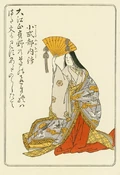
Lady Koshikibu past David Balderdash
Koshikibu no Naishi (female, 999-1025)
Genre
Others
Story
Kana-chan 's first bill of fare. This poem suits her for non only it begins with Ōe Mountain, simply for this verse form'due south meaning. It is the blend of cute scenery, poetic art and noble pride of woman.
The author, Lady Koshikibu no Naishi, was the daughter of Izumi Shikibu, one of the Sometime Xxx-six Poetry Immortals. Inheriting her mother's poesy, Koshikibu's talent had been recognized since her youth. Some people was fifty-fifty jealous of her talent, suspecting that her female parent might be ghost-writing for her.
1 24-hour interval, during when her parents were stationed in far Tango Prefecture as the officials, Koshikibu was invited to a poetry party of the Palace in Kyoto. Simply earlier information technology began, the host of the party, Fujiwara no Sadayori, mocked her, asking "Has your messenger to your mother in Tango already come dorsum? Tango is and so far that I've got worried if your female parent's letter (of ghostwritten poems) arrives in time."
Instead of bearing or raging, Koshikibu replied with an artful verse form. Literally, it tells the longing for visiting the famous scenery of Ama no Hashidate (The Sky'southward Bridge) in Tango, which is beyond Mount Oe and Ikuno aeroplane.
The route to Mount Oe and Ikuno'south manifestly are so very far. Thus I have not yet ever stride in The Sky's Bridge.
However, if y'all interpret it using rhetoric technique of Kake-kotoba(Pivot Words, phonological double-meaning), it becomes the response to Sadayori.
The road to Mount Oe, which is on the way to Tango, is then very far. Thus I have never seen The Heaven's Bridge in Tango. How could I have seen the letter that you mean?
Beingness ashamed by the brilliant poem, Sadayori ran abroad from the party despite that he was due to make a replying poem by the etiquette.
Unfortunately, she passed away at her age of 26. She left many practiced love poems, and information technology seems she later became a kind of idol amidst young women of that age.
Karuta Card Type
Three Syllable Carte (O-o-e)
61. Now Bloom Inside the Ninefold Palace
For The episode "Now Bloom Within the Ninefold Palace", run across Episode vi.
Inishie no/Nara no miyako no/Yae-zakura/Kyō kokonoe ni/Nioi nuru kana いにしへの 奈良の都の 八重桜 今日九重に にほひぬるかな
Author
Ise no Taifu
Genre
Spring scenery
Karuta Card Type
Ii Syllable Carte du jour (I-ni)
62.
Said night was immature when the false rooster crowed, just the gates of Osaka remained close.
Yo o komete/Tori no sorane wa/Hakaru tomo/Yo ni Ōsaka no/Seki wa yurusaji 夜をこめて 鳥のそらねは はかるとも よに逢坂の 関はゆるさじ
Author
Sei Shōnagon
Genre
Others
Karuta Card Type
Two Syllable Card (Yo-o)
63. After I Determined to Abandon
After I adamant to abandon my love, my only regret is that I accept no mode to tell you lot in person.
Ima wa tada/Omohi tae nan/To bakari o/Hitozutenara de/Iu yoshi mogana いまはただ 思ひ絶えなむ とばかりを 人づてならで いふよしもがな
Writer
Fujiwara no Michimasa (992-1054)
Genre
Love
Karuta Card Type
3 Syllable Bill of fare (I-ma-wa)
66. For There Is No 1 Else Out Here
For The episode "For In that location Is No I Else Out Hither", see Episode xiv.
Equally I said earlier, my love is fundamentally differnt from yours. - Episode six
Would the mountain cherry blossoms return my affection for in that location is no one else out here.
Let us ii sympathize, Oh mountain cherry tree; For in that location is no 1 other than me and your blossoms.
Morotomo ni/Enlightened to omoe/Yamazakura/Hana yori hoka ni/Shiru hito mo nashi もろともに あはれと思へ 山桜 花よりほかに 知る人もなし
Author
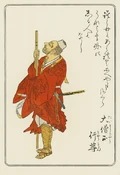
Old Chief Abbot Gyoson (male person, 1055-1135)
Onetime Principal Abbot Gyoson by David Balderdash
Genre
Others (Loneliness)
Story
Abbot Gyouson was built-in as a child of noble family in the Uppercase of Nara. Facing his father'due south expiry at his age of 12, he entered the priesthood and became seroious ascetic monk who underwent hard austere practices. I solar day during the practice, he stumbled across a beautiful mountain cherry tree in a deep mountain. The ruby-red blossoms reminded him of nostalgic memories he had experienced in his days at Capital. For being isolated erstwhile man, he asked the tree if it could yearn for him as he yearned for the cerise blossoms and its memories.
The scene of Kanade's traditional kimono clothing shop in Chihayafuru anime episode half dozen was not in the original manga version. Kana-chan reciting this poem while looking at kimonos past herself is awesome rendition on calculation a great flaver to the story! This poem may represent Kanade's heart; the feel of isolation and the love for traditional things, like no i other than kimonos share her distress.
Karuta Carte Type
Two Syllable Card (Mo-ro)
Former Principal Abbot Gyoson from David Bull'southward Hyakunin Isshu Woodblock print serial
Prototype Photo from Nonohana web log
68.
Every bit the years laissez passer, I will find myself longing for the sight of the midnight moon.
Kokoro ni mo/Arade ukiyo ni/Nagaraeba/Koishikaru beki/Yowa no tsuki kana 心にも あらでうき世に ながらへば 恋しかるべき 夜半の月かな
Author
Emperor Sanjō
Genre
Others
Karuta Card Type
4 Syllable Card (Ko-ko-ro-ni)
69. To Fix the Tatsuta River Ablaze
For The episode "To Set the Tatsuta River Ablaze", come across Episode 31.
The storm.......to fix the Tatsuta River afire.
By the wind tempest's blast From mimuro's mountationslopes Maples Leaves are torn which turn tatsuta river Into a rich brocade
Arashi fuku/Mimuro no Yama no/Momijiba wa/Tatsuta no Kawa no/Nishiki nari keri 嵐吹く 三室の山の もみぢ葉は 竜田の川の 錦なりけり
Author
The Monk Noin (male, 998-1050)
Genre
Autumn scenery
Karuta Carte du jour Blazon
Three Syllable Card (A-ra-shi-)
70.
When all alone
I leave my hut And gaze effectually, Everywhere it's the same Fall Twilight.
Sabishisa ni/Yado wo tachi idete/Nagamureba/Izuko mo onaji/Aki no yugure 寂しさに
宿を立ち出でて ながむれば いづこも同じ 秋の夕暮れ
Author
Monk Ryosen Hōshi (male, ca. 990 - ca. 1060)
Genre
Story
Ryosen Hōshi aka Ryozen equanimous it while doing austerities in a remote hut outside the upper-case letter. He was a monk at Mt. Hiei and likewise served as betto (ambassador) at Gionsha Shrine. He retired in Ohara, n of Kyoto. 30-two of his poems are extant.
The notion of "Autumn Sunset" appears a lot in Japanese poetry, but plainly its meaning differs depending on the fourth dimension and identify. Ryosen Hoshi gives a more melancholy, almost Buddhist, tone implying that the world effectually him is declining into wintertime and possibly, metaphorically declining in a general Buddhist sense. Yet, Sei Shonagon (poem 62) as well wrote almost Autumn Sunset in herPillow Book, but used information technology to describe crows and wild-geese flying.
Nagamu (gaze effectually) tin besides hateful 'lost in melancholy thoughts, chant or compose a poem'. Isn't that wonderful? The mind-scope of the ancient Japanese poets went from 'gaze out into the distance' over 'become lost in melancholy thoughts' to 'etch a verse form'.
An Autumn Sunset means a lot of different things to a lot of different people, merely information technology yet is significant one manner or another.
Karuta Menu Type
72. While Some Dodge the Famous Waves
"While some" is followed past "I deflect". I don't retrieve the entire poem. **Snap!** - Episode 12
While some contrivance the famous waves of Takashi shore to avoid getting wet, I deflect your aesthetic words to continue my sleeves dry out.
Well I know the fame of the restless waves that break on Takashi's shore. I ameliorate non let my sleeves wet by them, nor by your words.
Oto ni kiku/Takashi no hama no/Adanami wa/Kakeji ya sode no/Nure mo koso sure 音にきく 高師の浜の あだ浪は かけじや袖の ぬれもこそすれ
Author
Lady-in-Waiting Kii past David Bull
Lady-in-Waiting Yushi Naishin-no-ke no Kii (female person, 11th century).
Genre
Love
Story
Quoting Kanade,
This is a poem well-nigh how a adult female was able to successfully ward off a playboy's advances!
A highly artful and rhetorical poem with lot of double-meaning phrases.
Oto ni kiku= Hearing the audio of waves, hearing rumors
Takashi = The Shore of Takashi, much-talked
Kakeji = Not let something moisture, Not give center to someone
Sode no Nuremo- = wet one's sleeves past waves, moisture ane's sleeves by tears
Using these rhetorics, the brusk 31-syllable poem becomes very rich in content.
" I know the fame of your pick-up lines well like the famous waves of Takashi'southward Shore. They are bonny like the restless waves of the shore, right? When they visit the shore, they would exist conscientious not to allow their sleeves wet by waves. So I too shall be careful not to permit my sleeves moisture past my tears." Ameliorate next time, pretty male child!
Actually, the auther, Lady-in-Waiting Kii, was lxx years old when she wrote this poem at a poetry party. The theme of the party was "Exchanging Beloved Poems", a kind of role-playing love game that ladies and gentlemen exchange love poems each other and so bask reading them.
In the poem session, Lady Kii'southward partner was 29 years former handsome gentleman Fujiwara no Toshitada. His poem was a passionate 1;
人知れぬ 思いありその 浦風に 波のよるこそ 言はまほしけれ
To tell the truth, I'1000 giving my heart to you. Like bounding main waves break on Ariso'due south Shore with night breezes, I desire to visit your room at nighttime more once.
Recieving this aesthetic and rhetorical verse form, Lady Kii answered, or declined gracefully to be precise, with witty, more aesthetic and more rhetorical poem, while sharing the aforementioned topic.
Imagine the smiling of a pretty former woman and the bitter smile of a handsome young human being. How beautiful!
Karuta Menu Type
Two Syllable Card (O-to)
Yushi Naishin-no Kii from David Bull's Hyakunin Isshu Woodblock impress series
73. Nobody Wishes to See the Beautiful Cherry Blossoms
For The episode "Nobody Wishes to See the Cute Ruddy Blossoms", run into Episode 24.
For The episode "To Run across The Beautiful Cherry Blossoms", see Episode 48.
Takasago no/O no due east no sakura/Saki ni keri/Toyama no kasumi/Tatazu mo ara nan 高砂の 尾の上の桜 咲きにけり 外山の霞 立たずもあらなむ
Author
Ōe no Masafusa
Genre
Spring scenery
Karuta Menu Type
Two Syllable Card (Ta-ka)
76. The Cresting Waves Almost Look Like Clouds in the Skies
For The episode "The Cresting Waves Near Await Like Clouds in the Skies", see Episode twenty.
Wata no hara/Kogi idete mireba/Hisakata no/Kumoi ni magō/Oki tsu shiranami わたの原 こぎ出でて見れば ひさかたの 雲居にまがふ 沖つ白波
Writer
Fujiwara no Tadamichi
Genre
Others
Karuta Card Type
Six Syllable Card (Wa-ta-no-ha-ra-ko)
77. Swift Waters Parted by the Jagged Rocks
Then Ayase must accept started a Karuta club and then she could come across him at nationals. - Episode x
Swift waters parted by the jagged rocks are joined at river'due south end.
Though the stream is divided by a boulder in its swift flow, I know the twain will soon unite once again.
Se o Hayami/Iwa ni Sekaruru/Takigawa no/Warete mo sue ni/Awan tozo Omou 瀬をはやみ 岩にせかるる 滝川の われても末に あはむとぞ思ふ
Author
Emperor Sutoku (male, 1119-1164)
Genre
Beloved
Story
A nature poem which implicitly expresses the vow of parting lovers, who swear they will eventually meet over again. As Kanade quoted it in Episode 10, this may be the theme poem of the relationship between Chihaya and Arata. It must be more than coincidence that this is Chihaya'south very first carte she won at her first Karuta game against Arata.
Quite ironically during Mizusawa'south tertiary twelvemonth at the National High School Championship, playing against the Fujioka Eastward Loftier School Karuta Club for 3rd identify, Chihaya'due south opponent is Arata. But as Chihaya'southward unabridged attention is on being a captain and leading her team she is unaware of whom she is paired against and is winning with a high lead. Reiko, who is at Nationals with Mizusawa'due south other members' mothers, calls Taichi who has left the club at the outset of the year (Chihaya too leaves the society merely returns in time for regionals). Taichi's entry is noted by anybody except Chihaya and Arata. The former wanting to being an excellent captain and focusing on her and her squad'south win, and the latter desperately trying to make Chihaya enlightened that they are finally playing together. Arata swipes this card. Chihaya's attending is at last fatigued when Chihayafuru is chosen out, which is a expressionless card in the current game,but the offset person she notices is Taichi. Later on she goes back to her game she realises that she was playing Arata all this time. In the end Mizusawa wins 5-0 and Arata's defeat past Chihaya shocking everyone, especially Shinobu. But Chihaya's sole attention is on Taichi.
Trivia
While the entire serial point out that Chihaya and Arata's romantic relationship is of Star-crossed lovers, in Volume 31, Affiliate 163 Chihaya and Taichi are really and truly suited to this verse form.
Karuta Card Type
1 Syllable Card (Se)
79. Moonlight, Articulate and Bright
For The episode "Moonlight, Articulate and Bright", meet Episode 25.
Akikaze ni/Tanabiku kumo no/Tae ma yori/More izuru tsuki no/Kage no sayakesa 秋風に たなびく雲の 絶え間より もれ出づる月の 影のさやけさ
Author
Fujiwara no Akisuke
Genre
Autumn scenery
Karuta Bill of fare Blazon
Three Syllable Menu (A-ki-ka)
83. World Offers No Escape
For The episode "World Offers No Escape", run across Episode 17.
Merely you're using tennis as a substitute for Karuta! That's not fair to tennis. - Episode 8
The world offers no escape. Even I hide in the mountains, only to hear the haunting weep of deer.
In this world of ours, There is no way to float above hurting. Fifty-fifty lost in thought in the depths of the mountains, I hear the deer crying.
Yononaka yo/Michi koso Nakere/Omoi iru/Yama no Oku nimo/Shika zo Naku naru 世の中よ 道こそなけれ 思ひ入る 山の奥にも 鹿ぞ鳴くなる
Author
Fujiwara no Shunzei
Genre
Others (Think)
Karuta Card Blazon
Five Syllable Menu (Yo-no-na-ka-yo)
84. Equally the Years Laissez passer
For The episode "Every bit the Years Pass", see Episode 19.
May I live to meet the day when I long for the agony I feel now......
If I should live long, then perhaps the nowadays days may be honey to me, just as by time filled with grief comes quietly back in idea.
Nagaraeba/Mata Konogoro ya/Shinobaren/Ushi to Mishi yo zo/Ima wa Koishiki ながらへば またこのごろや しのばれむ 憂しと見し世ぞ いまは恋しき
Author
Fujiwara no Kiyosuke (male. 1104-1177)
Genre
Others
Story
This poem was equanimous by Fujiwara no Kiyosuke (1104-1177), with the title Ason, who was the second son of Fujiwara no Akisuke (poem 79). Subsequently his father's death he became the head of the Rokujo school of verse. He was the compiler of the ShokuShikashu and wrote treatises on poetry, like the Ogi Sho and Fukuro-zoshi. He belongs to the Thirty-Vi Immortal Poets. He has xc-6 poems in royal anthologies.
At middle, this poem is well-nigh nostalgia, how bitter things now somehow soften over time. Everyone can remember of a bitter fourth dimension in their life, but looking back nostalgia makes it seem sweeter than it was back then. It's besides a reminder that if nosotros are going through a hard time at present, it won't always be that way in the future.
Shinobu has 2 meanings, 'to comport, endure' referring to the foretime days of the first two lines, or 'to think of fondly, be cornball about' referring to the following lines; it's the swivel that connects both parts.
Some think this may have alluded to the decline of the times, and in particular the Hōgen Rebellion, mentioned also in poem 76 and verse form 77. Simply even if that were true, it's interesting how we tend to look back on this era with a kind of bitter-sweetness nostalgia, far removed from the hurting and destruction caused at the time.
Karuta Menu Blazon
Three Syllable Menu (Na-ga-ra)
86. May My Sighs Be Blamed upon the Moon
May my sighs be blamed upon the moon, or do my tears come from the feelings it evokes?
Should I blame the moon for bringing forth this sadness, as if it pictured grief? Lifting up my troubled face, I regard it through my tears.
Nageke tote/Tsuki ya wa mono o/Omowasuru/Kakochi gao naru/Waga namida kana 嘆けとて 月やは物を 思はする かこち顔なる わが涙かな
Author
Saigyo Hoshi (male. 1118-1190)
Genre
Others
Karuta Carte du jour Type
Three Syllable Carte (Na-ge-ke)
87. Rain Takes Longer to Dry
For The episode "Rain Takes Longer to Dry", run into Episode 35.
The passing shower's
Raindrops are nonetheless drying On the yew plum pines When yet the mist starts ascension On this autumn evening.
Murasame no/Tsuyu mo mada hunu/Maki no ha ni/Kiri tachi noboru/Aki no yūgure 村雨の 露もまだひぬ まきの葉に 霧立ちのぼる 秋の夕暮れ
Writer
Jakuren Hoshi
Genre
Fall scenery
Story
Jakuren Hoshi (1139 - 1202), with personal proper name Fujiwara no Sadanaga, was the son of Ajari Shunkai, brother of Shunzei (poem 83). He was adopted by Shunzei. With Teika (verse form 97) and Ietaka (poem 98) he frequented the Mikohidari salon of poetry. He contributed as an editor to the Shin Kokinshu. He has 116 poems in imperial collections.
The problem with the expression 'ascent mist' is that nosotros can either run into it as a lifting or wearisome disappearance of the mist, or on the reverse as a rising and increasing level of the mist.
Interestingly, the poetic versekiri tachinoboru (霧立ち上る) or "the mist is already rising", was coined by Jakuren and was associated with him by later poets and commentators.
Fujiwara no Teika, another member of the House of Mikohidari, didn't praise this poem at start, and it made the "cut floor" of the Imperial anthology that Jakuren helped compile, the Shin-Kokinshū, or in other anthologies. And yet, years later, it appears hither in the Hyakunin Isshu past Fujiwara no Teika. The verse form is generally viewed every bit a elementary, straightforward descriptive poem, which is possibly why it wasn't as highly revered as other more subtle poems, or poems with more than of a backstory.
Karuta Card Blazon
One Syllable Card (Mu)
89.
Nothing can exist worse than living a moment longer when I cannot acquit growing any weaker than I already have.
Like a string of gems, Grown weak, my life will interruption at present; For if I live on
All I do to hide me love May at concluding abound weak and fail
Tama no o yo/Taenaba taene/Nagaraeba/Shinoburu koto no/Yowari mo zo suru 玉の緒よ 絶えなば絶えね ながらへば 忍ぶることの 弱りもぞする
Author
Princess Shikishi
Genre
Love
Karuta Card Type
Two Syllable Carte du jour (Ta-ma)
93. The world offers no alter
The earth offers no change. I pray......
If just our world-- Could be always as it is!-- How moving the sight Of the trivial angling boat Drawn by ropes along the bank.
Yo no naka wa/Tsune ni mogamo na/Nagisa Kogu/Ama no Obune no/Tsunade Kanashi mo 世の中は 常にもがもな 渚こぐ あまの小舟の 綱手かなしも
Author
Kamakura no Udaijin (male, 1192-1219)
Genre
Parting
Karuta Card Type
5 Syllable Card (Yo-no-na-ka-wa)
97.As I Await For Someone
It really took you then long...those words are and so long overdue, Tsukue-kun.... - Chapter 173
As I wait for someone who will never come up, my trunk burns like the seaweed drying on the shores of Matsuho.
Like the salt seaweed, burning in the evening calm. On Matsuo's shore, all my being is aglow, waiting for her who does not come.
Konu hito o/Matsuho no ura no/Yūnagi ni/Yaku ya moshio no/Mi mo kogare tsutsu 来ぬ人を まつほの浦の 夕なぎに 焼くや藻塩の 身もこがれつつ
Writer
Fujiwara no Teika (male, 1192-1219)
Genre
Love
Karuta Card Type
Two Syllable Menu (Ko-nu)
98.The Only Sign of Summer
For The episode "The But Sign of Summer", see Episode 37.
Kaze soyogu/Nara no ogawa no/Yūgure wa/Misogi zo natsu no/Shirushi nari keru 風そよぐ ならの小川の 夕暮れは みそぎぞ夏の しるしなりける
Author
Fujiwara no Ietaka
Genre
Summer scenery
Karuta Menu Blazon
Three Syllable Bill of fare (Ka-ze-and so)
100.Exist As Dear At present, Those Were the Proficient Sometime Days
For The episode "Be As Dear At present, Those Were the Good Old Days", see Episode 30.
For The episode "Sets These Forbidden Fields Aflame", encounter Episode 12.
Going over the fields of murasaki grass
that shimmer ruby-red,
going over the fields marked every bit imperial domain,
will the guardian of the fields not run into you
as you wave your sleeves at me?
Y'all came to see me at forbidden field of crimson gromwell field. Won't the groundkeeper see that you are waving your sleeves at me?
Akane sasu/Murasaki-no yuki/Shimeno yuki/Nomori wa mizu ya/Kimi ga sode furu あかねさす 紫野行き 標野行き 野守は見ずや 君が袖振る
Writer
Nukata no Ōkimi (female person, seventh century)
Genre
Other
Story
Quoting Kanade;
It'south from X Thousand Leaves. The poem was written by Emperor Tenji'south wife (concubine), Lady Nukata. Information technology tells the story of when her former husband, Prince Oama, snuck into her husband's lands and waved to her. Lady Nukata was so happy to see him. Just she worried that someone might encounter them together. The human heart never changes... -Episode 12
Actually the poem doesn't mention anything almost dusk. Kana-chan lively imagined the sunset scenery from "cherry-red gromwell field" phrase. Gromwell is the material plant of purple dyestuff, which was very precious. Thus the gromwell field was staked out as the Emperor's property at that age. Lady Nukata and her quondam husband were secretly meeting at the treasured field of her present married man, who happen to be the Emperor of the nation. This must exist one of the nearly forbidden beloved one tin can imagine!
Kana-chan said in episode 12 that the human center never changes from ancient Japan to today. The intriguing is that the theme of this poem is also "never-changing love." By reciting this poem, she is telling that her sight of the fact that karuta cards are poetry won't change even subsequently she learns how to play it equally a game and every bit a sport.
Chihaya also recited this poem when she arrived at Oumi Jingu Station in Shiga Prefecture. There may exist 2 meanings; I, she is feeling the 1400-years history of Oumi and the connexion betwixt ancient people and nowadays her. Two, her feeling for Arata has never changed even now.
Lady Nukata is an unique historical effigy. Her official record was merely 1 line; "Lady Nukata was Load Kagami's girl who married with Prince Oama, and had Princess Tōchi." Notwithstanding she left many poems that eloquently tell her dramatic life. Actually the fact that she was a concubine of Emperor Tenji is simply a scholar's conjecture based on this verse form and the answer poem by Prince Oama. Somehow she is popular among onetime civilisation fangirls (like Kanade), and some mangaka including Michiko Satonaka and Waki Yamato wrote her biography manga.
References
↑ 1.0i.anemistranslation from "わがころもでにゆきはふりつつ (Snowfall falls upon my sleeves)"?
↑ 2.02.1ii.ii2.32.42.v2.6two.sevenii.viiiTranslations of the Drove of 100 poems on "Chihayafuru" Manga Bilingual Edition vol. 1


0 Response to "What Did The Poem That Was Next To Midori Yamato's Boby In Roblox Anime High School Say"
Post a Comment